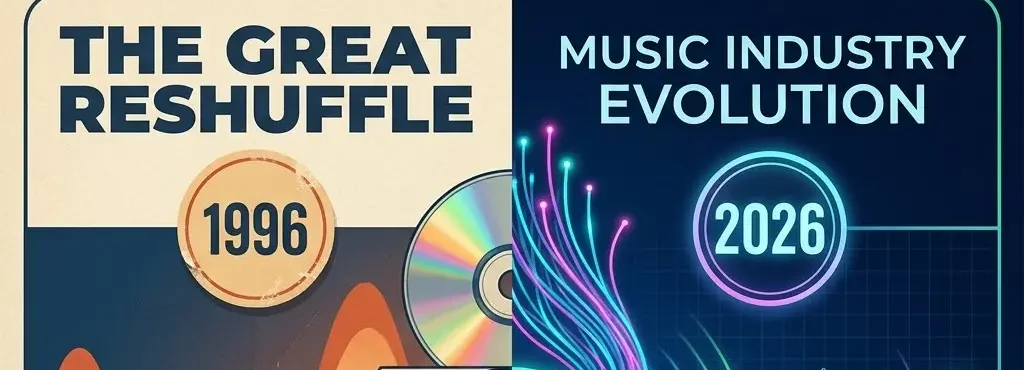
The Great Reshuffle
The music industry of 1996 and the music industry of 2026 share the same basic product—songs—but the machinery behind that product has undergone a total systemic collapse and reconstruction. Over the last three decades, we have transitioned from a scarcity-based model, where music was a physical commodity, to an abundance-based model, where music is a utility.
1. The Revenue Evolution: From Units to Access
Thirty years ago, the music industry was built on the “hit” economy. You bought a CD for $15, regardless of whether you only liked one song on it.
- 1996 (The CD Era): Revenue was driven by high-margin physical sales. A successful artist needed to move units to retail stores. If a listener wanted a song, they had to buy the entire album or a single. The profit per sale was high, and this funded long-term artist development.
- 2006–2014 (The Digital Void): The rise of MP3s and piracy (Napster, Limewire) broke the physical model. iTunes provided an “unbundling” solution (99-cent singles), but it couldn’t match the massive revenue generated by selling physical albums. Industry revenue plummeted to a 20-year low by 2014.
- 2026 (The Streaming Era): Today, music is a subscription service. Streaming accounts for the vast majority of industry revenue. We no longer buy music; we rent access to it. While this has returned the industry to record-breaking revenue heights (over $31 billion globally in 2025), that money is split among millions of creators, platform overhead, and label stakeholders, resulting in a “long tail” economy where only the top 0.1% generate massive wealth.
2. The Shifting Role of Record Labels
In 1996, a record label was a gatekeeper. They controlled the two things an artist absolutely could not survive without: Manufacturing/Distribution (getting CDs into Wal-Mart) and Mass Media Access (getting music onto radio and MTV).
Then vs. Now
Role | 1996 (Traditional Label) | 2026 (Modern Partner)
|
|---|---|---|
Distribution | Essential infrastructure (Physical) | Commodity (Digital aggregators) |
Gatekeeping | Absolute control over airplay | Diminished; social media bypasses gatekeepers |
Ownership | Usually held all masters long-term | Negotiated; often license-based or shorter term |
Development | Long-term investment in “slow growth” | High focus on data-driven “viral” potential |
Today, labels are increasingly acting as marketing agencies and financiers. Because anyone can distribute music via services like DistroKid or TuneCore, the label’s value has shifted from providing access to the shelf to providing the marketing velocity to cut through the noise of 100,000+ new songs uploaded to streaming platforms daily.
3. Is It Easier to Make Money Today?
This is the most debated question in the industry. The answer depends entirely on your definition of success.
It is easier to participate
In 1996, the barrier to entry was a massive check from a label. You needed a studio, a pressing plant, and a distribution network. Today, a teenager in a bedroom can record a hit on a laptop and distribute it to 150+ countries for $20 a year. The “democratization” of the industry is a reality—everyone has a seat at the table.
It is harder to sustain a living
- The Dilution Effect: Because the barrier to entry is low, the market is oversaturated. Standing out requires an immense, constant output of content, not just music, but social media engagement, video creation, and direct-to-fan marketing.
- The “Fractional” Paycheck: Streaming pays out in fractions of a cent. In the 90s, one fan buying a $15 CD was a tangible, significant event. Today, you need thousands of streams just to buy a cup of coffee.
- Touring as the Primary Revenue: In the 90s, touring was often a way to promote the album (which was where the money was). Today, the album is a business card to promote the tour (which is where the money is). Musicians are now essentially travel-based service workers who sell experiences, as recorded music has become a marketing tool rather than the product itself.
Summary Analysis
The last 30 years have been a transition from Music as a Product to Music as a Service/Brand.
For a musician in 2026, the strategy is no longer about selling copies of a recording; it is about building a community. Those who treat their music as the “top of the funnel” to sell merchandise, concert tickets, subscription content (Patreon/Substack), and unique fan experiences are finding stability. Those who rely solely on streaming royalties are often finding that while their music is being heard by more people than ever, the financial rewards are thinner than they have ever been.
