
Anti-Streaming in the United States
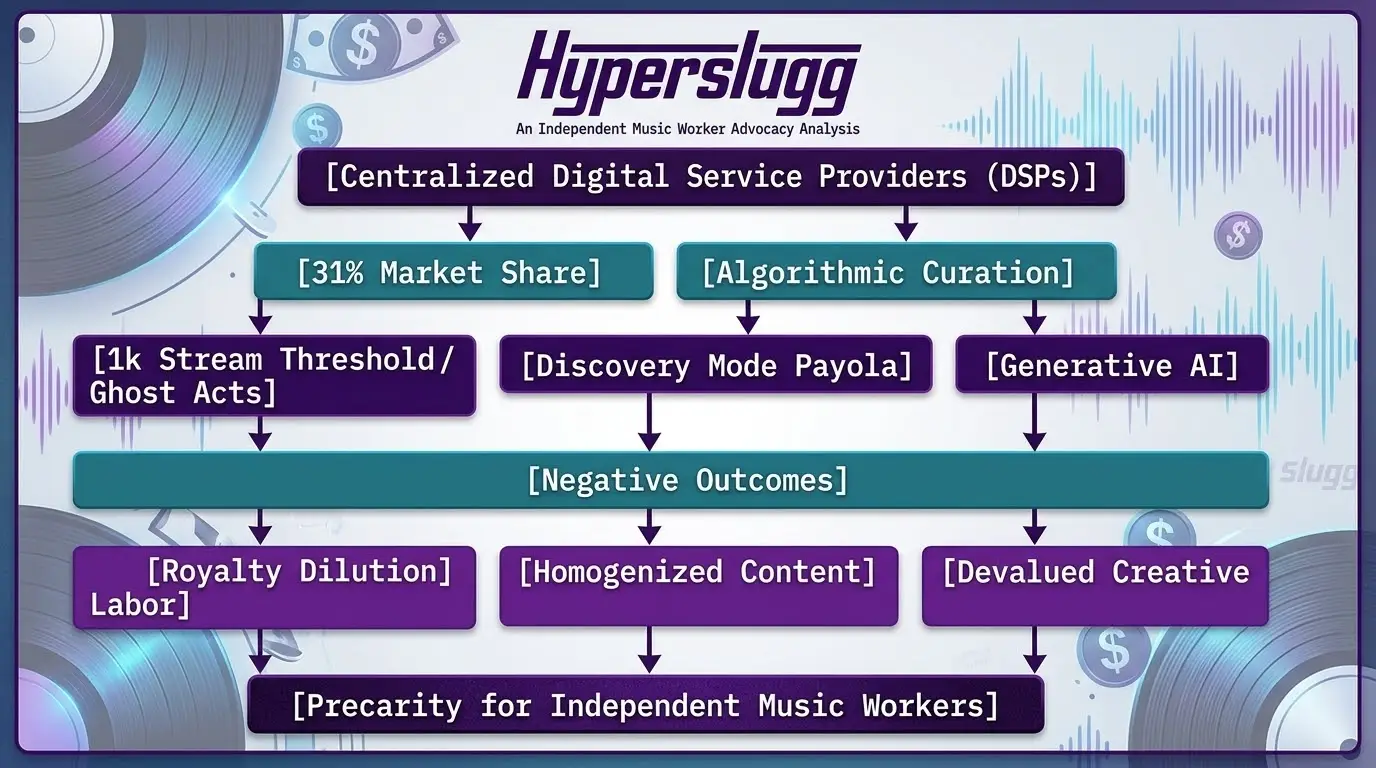
The political economy of the contemporary music industry is characterized by an asymmetric distribution of value, where centralized digital service providers (DSPs) extract significant capital from creative labor while systemic economic structures leave independent creators precarious. This imbalance has been driven by the consolidation of the streaming market, in which a single dominant platform controls approximately 31% of the global market share, dictating terms to millions of independent music workers who lack collective bargaining leverage. Under this model, recorded music has been commodified to serve platform retention metrics rather than to sustain the communities that produce it.
This economic precarity has been exacerbated by recent structural policy shifts. In April 2024, dominant streaming networks implemented a policy halting royalty payments on tracks that receive fewer than 1,000 annual streams. This threshold effectively demonetizes a large portion of the long-tail independent catalog, turning what was once marketed as an open, democratic platform into an extraction-based lottery system that favors the top 1% of commercially backed artists.
The baseline economics of the streaming model are inherently challenging for independent music workers: an artist requires approximately 250 to 300 streams to generate a single dollar of gross revenue, and a full-time minimum wage equivalent necessitates over 650,000 monthly streams per band member. Furthermore, promotional mechanisms such as “Discovery Mode” force independent artists to accept reduced royalty rates in exchange for algorithmic visibility, creating a digital payola system that further compresses margins.
Alongside these economic factors, the rise of algorithmic curation has reshaped how listeners discover and value music. Platforms prioritize passive, low-effort “lean-back” curation designed to keep users subscribed without demanding deep cognitive engagement. This dynamic incentivizes the production of homogeneous, inoffensive content that fades into the background, diminishing the cultural value of recorded audio.
Compounding this problem is the emergence of unlabeled, platform-licensed generative artificial intelligence (AI) tracks and “ghost artists”. By licensing human-authored tracks under pseudonyms or deploying generative AI audio within curated background playlists, platforms systematically reduce overall payouts to independent human creators.
These structural and economic challenges have intersected with ethical, political, and environmental concerns, catalyzing a broader movement. Backlash grew following reports that platform co-founder Daniel Ek’s finance firm invested nearly €700 million into Helsing, a military AI startup. This direct linkage between streaming revenue and defense technology prompted prominent independent and experimental acts—including Deerhoof, Xiu Xiu, Hotline TNT, Massive Attack, and King Gizzard & the Lizard Wizard—to pull their catalogs from the service.
Additionally, user boycotts were sparked by platforms running advertisements for Immigration and Customs Enforcement (ICE) recruitment. This convergence of corporate militarization, algorithmic exploitation, and royalty devaluing has fueled the growth of grassroots coalitions, labor organizations, and platform cooperatives across the United States.
Grassroots Anti-Streaming Collectives and Local Boycotts
Local collectives address consumer habits and regional organizing, focusing on shifting consumer behavior, educating music communities, and establishing localized solidarity networks to counter corporate distribution channels.
Death to Spotify (Oakland, California)
Initiated in September 2025 in Oakland, California, “Death to Spotify” emerged as a local forum series hosted at the Bathers Library, a community-supported art book library and workspace in downtown Oakland. The initiative was inspired by discussions surrounding critical music journalism, such as Liz Pelly’s Mood Machine, and the ethical backlash against platform executives investing in military technology. Originally conceived as localized file-sharing parties where participants moved their digital music libraries off streaming platforms and onto physical media (such as CDs or local hard drives), the forum quickly expanded into a sold-out lecture and panel series.
The collective brings together Bay Area radio hosts, disc jockeys, independent record label owners, and political organizers to discuss the decentralization of music discovery, production, and archiving. The organizers emphasize that their goal is not to eliminate streaming technology entirely, but to dismantle algorithmic listening habits, counter royalty devaluing, and reject unlabeled AI-generated music in favor of direct community support.
A central insight of the forum is the tension between the artist’s need for ethical production and the casual consumer’s desire for convenient access. By centering their efforts around local physical spaces and community hubs, the organizers seek to show that regional music ecosystems can sustain themselves through direct, localized engagement.
- Regional Focus: San Francisco, Oakland, and the broader Bay Area.
- Sign-Up and Contact Information: The host venue, Bathers Library, is located at 2310 Telegraph Ave, Oakland, CA 94612. The organizers and library curators can be reached directly via email at batherslibrary@gmail.com or on Instagram @batherslibrary. Information regarding upcoming forums, workshops, and community calendar submissions is hosted on their website at batherslibrary.cargo.site.
Seattle Artists Against Spotify (SAAS)
Formed in September 2025, Seattle Artists Against Spotify (SAAS) is an artist-led collective spearheaded by musician and former union organizer Carolyn Brotherton. The collective was galvanized by a series of platform errors and policy decisions, including the unauthorized, AI-generated attribution of songs to deceased legacy artists on official streaming pages, and the proliferation of “ghost artists” on curated playlist channels.
SAAS operates as a solidarity campaign rather than a traditional advocacy group. Members, including prominent local jazz, experimental, and psych-soul musicians, sign an open pledge to remove their entire catalogs from the platform. By coordinating collective catalog removals, SAAS aims to mitigate the isolation and professional anxiety independent artists experience when contemplating leaving major streaming services.
The group’s broader vision is to re-establish the cultural authority of the artist, arguing that the sustainability of the music community depends on direct-to-fan sales models rather than reliance on exploitative corporate intermediaries.
- Regional Focus: Seattle, Washington, and the Pacific Northwest.
- Sign-Up and Contact Information: Independent music workers, label owners, and regional DJs can join the pledge by filling out the signup form linked on the collective’s official Instagram profile: @seattleartistsagainstspotify. General inquires and solidarity messages can be sent via direct message through this channel or by contacting organizer Carolyn Brotherton through regional music networks.
National Music Labor Unions and Creator Advocacy Initiatives
National advocacy groups focus on systemic policy intervention, federal copyright reform, and collective bargaining for independent music workers across the United States.
Union of Musicians and Allied Workers (UMAW)
Launched in the spring of 2020 during the COVID-19 pandemic, the Union of Musicians and Allied Workers (UMAW) represents a major development in modern music labor organizing. Recognizing that independent music workers lack standard labor protections, unemployment benefits, and collective bargaining leverage, UMAW mobilizes artists, venue staff, record store clerks, and recording engineers under a unified labor framework.
The organization is entirely run by music workers and operates through active subcommittees focused on streaming equity, labor struggles, and direct action. UMAW operates several high-profile campaigns:
- Justice at Spotify: This initiative demands a minimum payment of one cent per stream, financial transparency, the public disclosure of closed-door contracts with major record labels, and an end to promotional practices resembling payola.
- #MyMerch: A campaign launched in partnership with the Featured Artists Coalition to pressure venues and festivals to end the practice of taking a percentage of artists’ physical merchandise sales.
- Fair Pay at SXSW: A direct action campaign demanding equitable compensation, the removal of application fees, and fair treatment for international artists performing at major industry showcase festivals.
In addition to grassroots direct action, UMAW collaborates with federal legislators, such as Representative Rashida Tlaib, to draft and advocate for policy reform aimed at establishing a federally mandated streaming royalty program.
- Organizational Scope: National labor organization with regional chapters in metropolitan centers including Chicago, New York, Los Angeles, Nashville, Boston, and San Francisco.
- Sign-Up and Contact Information: Musicians, engineers, and allied workers can become dues-paying members by completing the registration form at weareumaw.org/join. General inquiries, press requests, and chapter coordination messages can be sent through the primary organizational portal at weareumaw.org.
Music Workers Alliance (MWA)
The Music Workers Alliance (MWA) is a dues-paying, worker-run organization dedicated to securing economic justice and standard safety nets for independent, non-unionized music workers. Operating as a worker center, MWA focuses on lobbying at federal, state, and municipal levels for expanded access to social safety nets, including unemployment insurance, public funding for the performing arts, and anti-discrimination protections in live and recorded environments.
MWA prioritizes collective bargaining protections, fair contracting, and minimum wage scales for performances, particularly in live venues that stream performances online. The organization emphasizes that because independent music workers operate as precarious contract laborers, they must build collective economic power to demand accountability from both the public sector and corporate entertainment entities.
- Organizational Scope: National advocacy organization with a strong operational presence in New York State and the Northeast.
- Sign-Up and Contact Information: Music workers can join the alliance and set up monthly dues payments by registering online at musicworkersalliance.org/join or via the secure Action Network form at actionnetwork.org/forms/join-mwa. General inquiries, petition signatures, and campaign organizing messages can be directed to their central intake email address: musicworkersalliance@gmail.com. Contributions, monthly donations, and financial support are managed through their donation platform at music-workers-alliance.monkeypod.io/give/donate.
Artists Rights Alliance (ARA)
The Artists Rights Alliance (ARA) is an artist-run, non-profit advocacy organization representing the professional interests of songwriters, performers, and session musicians in the legislative and digital realms. Led by executive directors and an active music council, the ARA focuses on defending copyright integrity, lobbying for federal legislative protections against predatory generative AI, and enforcing fair trade practices in the digital marketplace.
In April 2024, the ARA coordinated a widely publicized open letter titled “Stop Devaluing Music,” signed by over 200 prominent artists, which called on digital music platforms to pledge against deploying generative AI tools that dilute royalty pools or replicate artists’ voices and likenesses without explicit consent.
- Organizational Scope: National policy advocacy and legal defense network.
- Sign-Up and Contact Information: The US-based organization coordinates legislative campaigns and publishes open resources through its online portal. For global artist rights and performance royalties coordination, the ARA works alongside the International Music Artists Rights Alliance (IMARA), chaired by Ms. Annie Morin, located at 122 Whinbush Rd, Hitchin, SG5 1PN, United Kingdom. Inquiries regarding international rights management, global AI policies, and performance licensing can be directed to info@imara.global.
Future of Music Coalition (FMC)
Founded in June 2000, the Future of Music Coalition (FMC) is a Washington, D.C.-based non-profit education, research, and advocacy organization. Unlike organizations focused strictly on labor mobilization, the FMC acts as an advisory body bridging the gap between musicians, legal scholars, technologists, and public policymakers.
The FMC conducts empirical research on artist revenue streams, health insurance access, media consolidation, and the public performance rights of sound recordings. The coalition has been a key advocate for net neutrality, arguing that an open internet is critical for independent artists to distribute their work without facing corporate throttling.
Additionally, through its Health Insurance Navigation Tool (HINT), the FMC historically provided direct advisory services to help uninsured and underinsured musicians access healthcare options.
- Organizational Scope: National non-profit research, education, and federal lobbying body headquartered in Washington, D.C..
- Sign-Up and Contact Information: Independent musicians and researchers can access policy whitepapers, participate in national artist surveys, and contact staff through the primary organizational portal at http://www.futureofmusic.org. General inquiries can be directed via the online contact interface or by subscribing to their programmatic updates.
Platform Cooperativism, Digital Marketplaces, and Library Streaming Networks
Independent developers, artists, and archivists have constructed alternative digital architectures based on platform cooperativism, community ownership, and public institution licensing.
Subvert (subvert.fm)
Launched in May 2026, Subvert is a community-owned online music marketplace built as a direct cooperative alternative to corporate digital service providers and venture-capital-owned platforms. Structurally, Subvert employs a dual-entity model comprising the Subvert Cooperative LCA (a Limited Cooperative Association incorporated under Colorado law, owned by artists, labels, supporters, and workers) and Subvert Inc. PBC (a Public Benefit Corporation wholly owned by the cooperative and registered in Delaware). This design allows the platform to raise traditional investment capital while legally securing voting control and ownership in the hands of its active community.
Subvert operates on a 0% platform fee model. When a user purchases digital music, the entirety of the transaction goes directly to the artist or label, while the platform’s operations are sustained through voluntary, optional contributions at checkout. Subvert maintains a strict anti-AI policy, manually reviewing applications for human authorship of both audio files and accompanying visual artwork. The platform supports MP3, FLAC, WAV, and AIFF files, and its roadmap includes expanding into physical merchandise and media sales.
- Organizational Scope: International cooperative marketplace serving independent artists and labels across 120 countries.
- Sign-Up and Contact Information: Artists and record labels can apply for free membership by completing the digital submission form at subvert.fm. Supporters who are not content creators can purchase a lifetime co-ownership share for a one-time fee of $100 directly through the homepage. General inquiries and support requests should be directed to info@subvert.fm, while active platform bugs can be reported to alpha@subvert.fm.
Catalytic Sound
Founded in 2012 by jazz musician and composer Ken Vandermark, Catalytic Sound is an artist-run cooperative designed to support the financial and creative autonomy of contemporary improvised and experimental musicians. The cooperative functions as a collective merchandise store, publisher, and digital streaming service through “Catalytic Soundstream”.
Under Catalytic Sound’s business model, 50% of the net income generated from physical and digital sales goes directly to the musicians, while the remaining 50% covers the collective’s operating costs, project development, and shipping logistics. Crucially, the subscription revenue generated from the Catalytic Soundstream platform is distributed equally among all participating artists in the collective, bypassing the play-count-driven models of corporate streaming.
- Organizational Scope: Artist-directed streaming and publishing cooperative based in Chicago, serving improvisational musicians across the United States and Europe.
- Sign-Up and Contact Information: Fans and prospective artist patrons can subscribe to the Soundstream streaming service or purchase releases directly at catalyticsound.com. General inquiries, label collaborations, and artist submission questions can be submitted via the contact portal at catalyticsound.com/contact/ or by emailing the collective directly at privacy@catalyticsound.com.
MUSICat by Rabble
An innovative development in alternative streaming is the integration of digital music archives into public library systems. MUSICat, an open-source software platform developed by the technology startup Rabble, enables public library systems across the United States—including Seattle, Madison, Minneapolis, and Edmonton—to establish localized, commercial-free streaming collections.
Under this model, libraries license recorded music directly from regional independent artists, offering an upfront, non-exclusive licensing fee (typically ranging from $200 to $250 for a two-year period). This structure provides artists with immediate compensation and introduces their catalogs to local library cardholders without algorithmic interference or subscription paywalls.
- Organizational Scope: Municipal licensing platform operating through dozens of local public library partners in the United States and Canada.
- Sign-Up and Contact Information: The software development and library onboarding team at Rabble can be contacted for demonstration requests, open-source code contributions, and partnership inquiries via email at info@musicat.co or by filling out the intake form at musicat.co. For regional artists wishing to submit their work for municipal licensing, applications are managed locally through corresponding library portals, such as the Shreve Memorial Library licensing intake at smllogjam.org/submit or Kent District Library’s Vibes program at vibes@kdl.org.
Electric Lady Bird
A prominent regional example of the MUSICat library model is Electric Lady Bird, a curated local music platform run by the Austin Public Library in collaboration with the Texas Music Office. The platform uses regional panels of community curators to select and license music from Central Texas artists, hosting the files on a user-friendly digital library interface funded through public municipal resources.
- Regional Focus: Austin, Texas, and the surrounding Central Texas region.
- Sign-Up and Contact Information: Central Texas musical artists can submit their albums for licensing consideration during open submission windows. Inquiries regarding submission schedules, licensing agreements, and municipal coordination can be directed to coordinator Celina Zisman at 512-530-5068 or via email at Celina.Zisman@FlyAustin.com. General application submissions are processed through the City of Austin’s Economic Development Department Portal at austintexas.gov/arts-culture/public-performance-program.
Historic Platform Post-Mortem: Defunct Cooperatives
When evaluating platform options, independent artists should note the status of older cooperative structures that pioneered these models but are no longer active:
- Resonate: This ethical streaming cooperative pioneered the “Stream2Own” model, where subscription-free listeners paid a fraction of a cent per play, doubling with each subsequent stream until permanent ownership was established. However, due to funding shortfalls, code errors, and operational challenges, the Resonate cooperative officially dissolved. The streaming catalog and account registration features are permanently locked, though the community discussion forums remain accessible at resonate.coop as long as server funding permits.
- Ampled: This Patreon-like subscription platform was 100% owned by its artists, workers, and community to provide predictable, direct-to-creator monthly revenue. Despite building an active membership of hundreds of artists, Ampled ceased operations at the end of 2023 due to founder burnout, lack of startup capital, and the challenges of managing cooperative growth on a volunteer basis. The platform did not transition into a Web3 DAO, and its core developers subsequently channeled their efforts into building Subvert as a successor.
Cooperative and Democratic Record Labels
Beyond distribution platforms and advocacy groups, the cooperative model has also been applied to record label structures, offering alternative paths for funding, catalog development, and artistic consensus.
Dreams of Field Recordings (DoFR)
Co-founded in January 2020 by independent musicians Christian Holden (of the band The Hotelier) and Chad Matheny (Emperor X), Dreams of Field Recordings (DoFR) is a prominent example of a democratically managed, cooperative record label. The label’s operations are guided by three core structural pillars:
- Non-Profit Motive: The label’s foundational bylaws require that 100% of profits are directly reinvested into the member-artists and their releases, removing the commercial incentive to only sign acts with high commercial probability.
- Democratic Consensus: Major strategic decisions, including the acquisition of new artist catalogs or the allocation of release budgets, are made on a consensus basis by a board composed of all signed artists on the label.
- Total Transparency: DoFR publishes detailed financial statements on its website, including all revenue streams and operational costs, to demystify capital flows within independent music communities.
Artists interested in participating can access catalog releases and contact the cooperative at dreamsoffield.com, or view their digital operations via their Bandcamp portal at dreamsoffieldrecordings.bandcamp.com.
Elestial Sound
Founded in September 2011 in Gainesville, Florida, by Davis Hart and Gabriel Ortiz, Elestial Sound began as an experimental electronic music label that transitioned into an artist-led cooperative in late 2013. Without existing blueprints for cooperative label governance, the founders adapted producer and worker cooperative models from the grocery industry to draft their bylaws.
The cooperative operates on a dynamic equity split system, where member-owners earn equity in the label relative to their active contributions (such as managing live production, sound engineering, marketing, or tour logistics). Additionally, the cooperative functions as a live production collective, designing immersive, site-specific art installations and managing touring services.
New Amsterdam Records (NewAm)
New Amsterdam Records is a Brooklyn-based, non-profit community cooperative label and artist service organization founded in 2008 by composers Judd Greenstein, Sarah Kirkland Snider, and William Brittelle. NewAm was established to support composers and performers whose work transcends traditional genre boundaries, particularly those sitting between classical, indie rock, jazz, and experimental music.
Granted 501(c)(3) status in 2011, NewAm operates as an artistic service organization supported by grants, donations, and traditional sales. The label has released over 120 records, receiving multiple Grammy Awards and a Pulitzer Prize.
To expand its reach, NewAm entered into a partnership with Nonesuch Records in 2019 to co-release select albums by contemporary American composers. This collaboration allows artists to utilize NewAm’s non-profit, community-based developmental structure while leveraging Nonesuch’s global distribution and marketing resources. Artists, composers, and performers matching this post-genre profile can access updates and contact the label at newamrecords.org.
National and Regional Directory of Active Initiatives
The following directory provides a comprehensive list of active organizations, grassroots boycotts, advocacy groups, and cooperative platforms in the United States. It includes verified registration links, physical locations, and primary communication channels.
Organization Name | Focus / Type | Headquarters & Address | Primary Contact Information | Registration & Sign-Up Channels |
|---|---|---|---|---|
Subvert | Cooperative Music Marketplace | New York, NY & Lisbon, Portugal | info@subvert.fm | Apply for free Artist/Label Membership directly at subvert.fm. Supporters can purchase lifetime co-ownership shares for $100. |
Union of Musicians and Allied Workers (UMAW) | National Labor Union & Advocacy | Nationwide; regional urban chapters | weareumaw.org | Access membership forms, pay monthly solidarity dues, and join organizing committees via weareumaw.org/join. |
Music Workers Alliance (MWA) | National Worker Center & Lobbying Group | New York, NY | musicworkersalliance@gmail.com | Register as a voting music worker at musicworkersalliance.org/join or through actionnetwork.org/forms/join-mwa. |
Seattle Artists Against Spotify (SAAS) | Local Boycott & Solidarity Campaign | Seattle, WA | Instagram: @seattleartistsagainstspotify | Regional independent musicians can sign the collective pledge to remove catalogs via the link in their official Instagram bio. |
Death to Spotify | Local Discussion & Archiving Forum | Oakland, CA; hosted at Bathers Library | batherslibrary@gmail.com | Contact the organizers at 2310 Telegraph Ave, Oakland, CA 94612, or submit inquiries through the contact forms at batherslibrary.cargo.site. |
Artists Rights Alliance (ARA) | National Copyright & AI Policy Advocacy | Washington, D.C.; global operations | info@imara.global (International) | Sign active open letters, participate in national policy campaigns, and track legislation via rightsclick.com/resources/. |
Future of Music Coalition (FMC) | Academic Policy & Industry Research | Washington, D.C. | Participate in academic artist revenue surveys and access regulatory filings through the main research portal at futureofmusic.org. | |
Catalytic Sound | Improvised Music Streaming Co-op | Chicago, IL | info@catalyticsound.com | Access the streaming service at catalyticsound.com or contact the collective for label partnerships at catalyticsound.com/contact/. |
MUSICat / Rabble | Library Software & Municipal Licensing | Madison, WI & Pittsburgh, PA | info@musicat.co | Contact for municipal software integration at musicat.co. Submit music for local licensing through regional library portals like smllogjam.org/submit. |
Electric Lady Bird | Curated Library Streaming Collection | Austin, TX; Austin Public Library | Celina Zisman: Celina.Zisman@FlyAustin.com | Regional Central Texas artists can submit music during open call periods via austintexas.gov/arts-culture/public-performance |
—
Strategic Selection Framework for Independent Artists
Choosing an alternative platform or advocacy group requires analyzing an artist’s specific career phase, primary revenue streams, and long-term professional objectives. The following matrix evaluates active organizations based on target demographics, governance structures, financial return models, and strategic career alignment.
Organization Name | Core Pricing & Financial Model | Governance & Ownership Structure | Ideal Artist Target Demographic | Recommended Alignment (Career Goals) |
|---|---|---|---|---|
Subvert | 0% platform transaction fee; operations funded by optional customer tips. | Multi-stakeholder cooperative; owned and governed by artist, label, and supporter members. | Independent artists, DIY record labels, and self-managed multi-project acts. | High-priority direct-to-fan digital catalog sales, permanent file ownership, and community-led governance. |
Seattle Artists Against Spotify (SAAS) | Non-commercial collective solidarity campaign. | Informal, localized artist-led coalition. | Seattle-based regional artists, particularly in jazz and experimental genres. | Regional community integration, ethical alignment through a complete boycott of corporate streaming. |
Union of Musicians and Allied Workers (UMAW) | Dues-supported; advocacy-focused. | Democratically structured labor coalition. | Working musicians, live touring acts, and venue staff. | Broad labor advocacy, ending venue merch cuts, federal streaming royalty reform, and fair festival pay. |
Music Workers Alliance (MWA) | Dues-paying worker center model. | Member-owned labor group. | Independent contract laborers, sound engineers, gigging live musicians. | Securing social safety nets (unemployment insurance), fair gig contracts, and municipal performative labor laws. |
Artists Rights Alliance (ARA) | Non-profit; policy-driven. | Led by executive directors and an active Music Council. | Songwriters, lyricists, commercial performing artists. | Federal copyright protections, defense against unauthorized AI model training, and platform licensing compliance. |
Future of Music Coalition (FMC) | Non-profit research center. | Academic/policy advisory board. | Academic music scholars, composers, policy advocates. | Accessing comprehensive industry revenue research, supporting net neutrality, and advocating for public performance rights. |
Catalytic Sound | 50/50 sales split; equal-share streaming subscription pools. | Artist-directed cooperative. | Avant-garde, free jazz, and contemporary improvised musicians. | Niche genre curation, physical merchandise distribution support, and community-curated streaming. |
MUSICat Library Networks | Upfront flat-rate, non-exclusive municipal licensing fees. | Public library-mediated, open-source infrastructure. | Hyper-local and regional independent musical artists. | Debt-free local capitalization, civic catalog preservation, and regional listener discovery. |
